
Currently, there is a heightened and almost sustained interest in the issue of race/ethnicity since the COVID-19 Pandemic demonstrated an unequal effect on people of different races/ethnicity with “minoritised groups” bearing the brunt of this devastating pandemic in the form of illness, deaths, loss of income to name a few.1,2
In the effort to address these glaring disparities or inequalities depending on which side of the Atlantic you reside, there is now an increase in research funding and outputs across different domains of healthcare and beyond but the rhetoric remains the same.3–5 People from Black, Asian and Mixed ethnic groups in that order tend to have worse outcomes and experiences in comparison to their White peers.5 Having accounted for any other difference that may exist such as employment choice, income, where they live etc these differences remain.5–7 For decades, Sociologists, have suggested this may be due to racism in particular structural racism that is enshrouded in how policies and processes lead to inequalities amongst different ethnic groups with a tendency to favour those of a White ethnic background solely on phenotypic characteristics only.6,8 Recently, Public Health and other domains of health are now accepting the issue of racism and looking at ways to address it.9,10 However, just as the blind cannot lead the blind as both will end in a ditch so also is the issue of trying to tackle racism by the current approaches of “fighting this social violence”.
First, let us look at the definition of race and ethnicity and understand why both terms are sometimes used interchangeably. Race is traditionally associated with physical features, most especially colour, while ethnicity as a word has its roots in the Greek word “ethnos” meaning nation or people. The current usage of ethnicity is socially constructed based on the “social group a person belongs to, and either identifies with or is identified with by others, as a result of a mix of culture, language, diet, religion, and ancestry.11 Just as the title of this post suggests, I propose to you that there are only two races existing in our world. The race of Adam i.e. the Human race and the race of Christ, i.e. Jesus Christ. (1 Corinthians 15:22, 45).
Every human born on earth is descended from Adam as Adam was the first man created, hence we can refer to humans as belonging to the race of Adam or the “Adamic race”. Creation has been proven over and over again in both fields of Science and amongst Sociologists who have traced the story of creation reported in the Bible and in various excerpts of written folklore from different parts of the world.12,13 Since the fall of man in the first garden (Garden of Eden – Genesis 3), the Adamic race is only capable of doing wrong despite its best efforts.
“The heart is deceitful above all things, and desperately wicked, who can know it” (Jeremiah 17:9, KJV).
Before Adam disobeyed God, Adam had the very nature of God in the beginning (Gen 2:7). He was already like God but somehow in the garden of Eden, he lost sight of that and fell for the trick of the serpent who told Eve they would be like God. Taking the forbidden fruit was a rejection of the nature of God he had in the very beginning and instead of becoming like God, he lost his connection with God, leaving him with a nature only capable of doing wrong. You only need to examine your thoughts and your dealings with your closest family members! Since the fall of man, the Adamic race we all inherited has only caused havoc and pain in our world. Brothers kill each other (Cain and Abel – Genesis 4:1-16), nations of the same tribe at war (10 tribes vs. 2 tribes of Israel – 1 Kings 12 and 2 Chronicles 10) and all seek only their own interests (Genesis 11:1-4).
Relating the issues of the Adamic race to our contemporary times, the slave trade could only happen because of the tribal chiefs willing to sell their people. Some of
the heroes/heroines celebrated in Africa were slave bandits and traders – raiding villages capturing them as slaves and selling them in exchange for gunpowder.14,15 But because the race of Adam does not accept its own fault and likes to blame others for their own errors just as Adam blamed his dearly beloved “Woman” who became “Eve” after the fall (Genesis 3:12, Genesis 4:1). While statues and history books are being re-written in the West, there is a lack of acceptance of the role of Africa in enabling the slave trade. This, I believe is the other side of the narrative that is difficult to accept and not easily accessible in the literature. No one is willing to admit their own part but seeks to heap the blame on others. So, what is the way forward?
Figure 1. The death of the “Adamic nature” and the birth of a “new life” in Jesus Christ
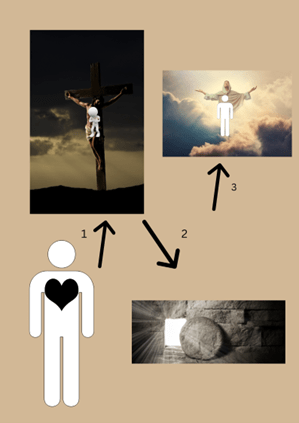
Figure 1 illustrates what happens when a “man” who inherited a sinful heart in Genesis 3 receives a new heart through the death of Jesus Christ at the cross and through resurrection can live a new life in Jesus Christ.
The only solution for our present dispensation is Christ. Jesus Christ was the second Adam, another race who like Adam was tempted in another garden (Garden of Gethsemane – Luke 22:39-46) but he did not yield to it but instead became the ultimate sacrifice by dying on the cross at Calvary for the sins of the sons of Adam (1 John 2:2). His victory over sin was not only at the cross but at His resurrection so He reigns over sin and death! His death and resurrection mean for all who will come to Him and accept Him as paying the price for their sin will have the nature they inherited from Adam destroyed and instead have the life of Christ at work in them (Romans 6) (Figure 1). The Christ life is the only one that can achieve social justice (Isaiah 11:1-5). This is because it is a life of love and reconciliation (John 3:16, 2 Corinthians 5:11-21).
Have you been affected by the issues of race/ethnicity, do not get embittered and see one race as superior to yours or play the victim? Are you willing to commit to social justice in your own sphere of influence? Why not seek the true race (1 Peter 1:9) that Heaven rejoices over and seek His direction for how to reconcile instead of widening the disparities/inequalities?
Written by Dr Oluwaseun Esan
Research Fellow, University of Liverpool
References
1. Public Health England. Disparities in the risk and outcomes of COVID-19 [Internet]. Available from: https://assets.publishing.service.gov.uk/government/uploads/system/uploads/attachment_data/file/908434/Disparities_in_the_risk_and_outcomes_of_COVID_August_2020_update.pdf
2. Pan D, Sze S, Minhas JS, Bangash MN, Pareek N, Divall P, et al. The impact of ethnicity on clinical outcomes in COVID-19: A systematic review. eClinicalMedicine [Internet]. 2020 [cited 2022 Jul 19];23. Available from: https://doi.org/10.1016/j.eclinm.2020.100404
3. Esan O, Adjei NK, Saberian S, Christianson L, McHale P, Pennington A, et al. Mapping existing policy interventions to tackle ethnic health inequalities in maternal and neonatal health in England: A systematic scoping review with stakeholder engagement [Internet]. 2022 Dec [cited 2023 Feb 8]. Available from: https://www.nhsrho.org/wp-content/uploads/2022/12/RHO-Mapping-existing-policy-interventions_December-2022.pdf
4. Jardine J, Walker K, Gurol-Urganci I, Webster K, Muller P, Hawdon J, et al. Adverse pregnancy outcomes attributable to socioeconomic and ethnic inequalities in England: a national cohort study. The Lancet [Internet]. 2021 Nov 20 [cited 2023 Feb 8];398(10314):1905–12. Available from: https://www.thelancet.com/journals/lancet/article/PIIS0140-6736(21)01595-6/fulltext
5. Dharmi Kapadia JZ, Sarah Salway JN, Andrew Booth N, Villarroel-Williams L, Esmail B& A. Ethnic Inequalities in Healthcare: A Rapid Evidence Review [Internet]. 2022. Available from: https://www.manchester.ac.uk/discover/news/services/downloadfile.php?f=rho-rapid-review-final-report-v.7.pdf&uid=1139877&hash=8c1f63a90532ae3ede061168dad317e77b0447d6
6. Nazroo JY. The structuring of ethnic inequalities in health: economic position, racial discrimination, and racism. Am J Public Health. 2003;93(2):277–84.
7. Kmietowicz Z, Ladher N, Rao M, Salway S, Abbasi K, Adebowale V. Ethnic minority staff and patients: a health service failure. BMJ. 2019 May 21;365:l2226.
8. Nazroo JY, Bhui KS, Rhodes J. Where next for understanding race/ethnic inequalities in severe mental illness? Structural, interpersonal and institutional racism. Sociol Health Illn [Internet]. 2020 Feb 1 [cited 2022 Oct 17];42(2):262–76. Available from: https://doi.org/10.1111/1467-9566.13001
9. The Lancet. Advancing racial and ethnic equity in health. The Lancet [Internet]. 2022 Dec 10 [cited 2023 Feb 8];400(10368):2007. Available from: https://www.sciencedirect.com/science/article/pii/S0140673622025338
10. Racism as the fundamental cause of ethnic inequities in COVID-19 vaccine hesitancy: A theoretical framework and empirical exploration using the UK Household Longitudinal Study – ScienceDirect [Internet]. [cited 2023 Feb 24]. Available from: https://www.sciencedirect.com/science/article/pii/S235282732200129X?via%3Dihub
11. Johnson MRD, Bhopal RS, Ingleby JD, Gruer L, Petrova-Benedict RS. A glossary for the first World Congress on Migration, Ethnicity, Race and Health. Public Health [Internet]. 2019 Jul 1;172:85–8. Available from: https://www.sciencedirect.com/science/article/pii/S0033350619301362
12. Science Confirms Biblical Creation [Internet]. [cited 2023 Feb 24]. Available from: https://www.icr.org/article/science-confirms-biblical-creation
13. Creation Stories from Around the World [Internet]. Answers in Genesis. [cited 2023 Feb 24]. Available from: https://answersingenesis.org/creationism/creation-stories-around-world/
14. Ogunleye F. A Male-Centric Modification of History: ‘Efunsetan Aniwura’ Revisited. Hist Afr [Internet]. 2004 [cited 2023 Feb 24];31:303–18. Available from: https://www.jstor.org/stable/4128529
15. African Participation and Resistance to the Trade · African Passages, Lowcountry Adaptations · Lowcountry Digital History Initiative [Internet]. [cited 2023 Feb 24]. Available from: https://ldhi.library.cofc.edu/exhibits/show/africanpassageslowcountryadapt/introductionatlanticworld/african_participation_and_resi
 Mystery of The Gospel
Leave a comment